
How to change an acquired technique or learn a new technique with a new device without dropping out of balance
From coaches and trainers you will probably often hear the words that you are supposed to listen to your body, first consciously and – even better – unconsciously. Body and mind should form one entity. This means you have to proceed in a way that your body-mind balance is sustained. Easy said, difficult to achieve.
The phrase undoubtedly indicates a general trend towards a holistic view of the organism. It is influenced by a mixture of views borrowed from biology, psychology, naturopathy, sport science, sport medicine, nutrition science, personal experience…and more. But the appeal to you remains vague, you have to find out yourself, what it is like to be in a state of balance with your mind and body.
Using the computer as a body metaphor avoids this mess of viewpoints, and quickly shows what changes mean for the body computer. The greater the difference between a body state you are used to and the condition you are trying to obtain, the greater the processing demands for your body. Training is nothing less than practicing the processing operations. Exercises must be repeated until for example the paths of nerve connections are established which then enable a stable channeling of the impulses. Whenever well trained signal constellations (sensory stimuli, impulses from your senses to the spinal cord and brain) are existent, they are automatically processed into the desired movement pattern without even touching your consciousness, and that occurs even under extreme stress. It might sound rather trivial to those, who have had to relearn speaking after a stroke, just as to a child that must learn to eat with a spoon, or an athlete who wants to improve his/her running or cycling technique. It is all about reiterating and spacing a stimuli pattern.
Searching for a constellation of stimuli that can be best processed by the body computer
This assignment is not trivial. You probably know how difficult it can be to correct a trained, but wrong movement pattern, such as a wrong swimming or running technique. It is made even more difficult by the fact that you can’t tell if you have been ‘practicing’ the proper technique, nutrition or training scheme, until you have practiced for a while.
There is no way of gaining knowledge about whether your training is adequate without giving the body some time. Unfortunately, impatience is a constant companion of many athletes. Changing training methods or devices too early may spoil your build-up, but who can tell you, when it’s time to change. It’s only you who can assess this.
Body perception or feeling good is the most complete body parameter
Chris McCormack – Triathlon World Champion Long Distance 2010 – says that the whole trick is, to know what it means to feel really good. Only under such circumstances it is possible to peak on time and remain uninjured. Training and becoming tired, reaching limits without wrecking yourself, is an art that only few can master. An art, because no more direct and complete but at the same time immeasurable parameter than body perception exists to reach this goal. This is still the case, even though we got so many devices to measure. There are tools that can guide our way to wellbeing such as heart rate, lactate, urea, creatine kinesis, oxygen consumption, electrolytes, micronutrients, inflammatory parameters etc., and there are the indirect methods such as being healthy, not suffering from injuries, pain or infections. But in the very end, we have to decide by experience when we are really feeling good.
The goals and the technique may vary, but the process is always the same
Body perception is a feeling that is acquired, when the gap between target – and actual condition closes. It requires motivation and practice, training. As a child you learn to ride a bike, because you would like to move faster and more independently, or because others do so. As a triathlete, the relation to your bike changes. You will try to ride quickly with the least possible strain. The bike and all its technical details are analyzed and questioned and so is the process of riding itself. Wheels, pedal position, frame size and handle position are all given their own importance. The motion cycle is analyzed and the perception from child age is taken apart and put back together and improved until a new perception has emerged – a new oneness between you and your bike.
This procedure does not always work. It requires a lot of practice and training. In the best case you melt into one with your bike. You move as safely as on two legs. You do not even notice it anymore: it becomes a part of you. But if the structure of your bike changes this process begins anew. The changed incoming stimuli patterns change your perception of the bike and interrupt your movement pattern, until a new balance is calculated through practice.
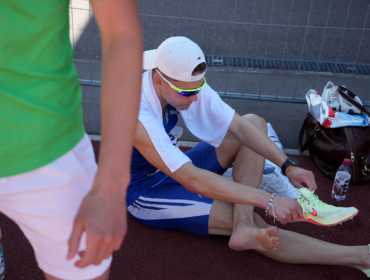
Countless examples could be named here. The same applies to such simple objects as a shoe. Whereas, shoes are especially stubborn companions. A shoe that does not distort your body perception is worth a lot. The smallest change to the sole, a body part very sensitive to wellbeing and body perception, can give you the feeling of being impaired. Therefore: Never change a winning team. This applies to things as well as humans, one can hardly believe it.
Können Gefühle lügen
von Sebastian Kienle, Deutsch
And here the link to the “Masters” blog
My thoughts on training
by Chris McCormack